
Dunjaluk: «In Sevdah there is rebellion that is often only subtly expressed, even masked»
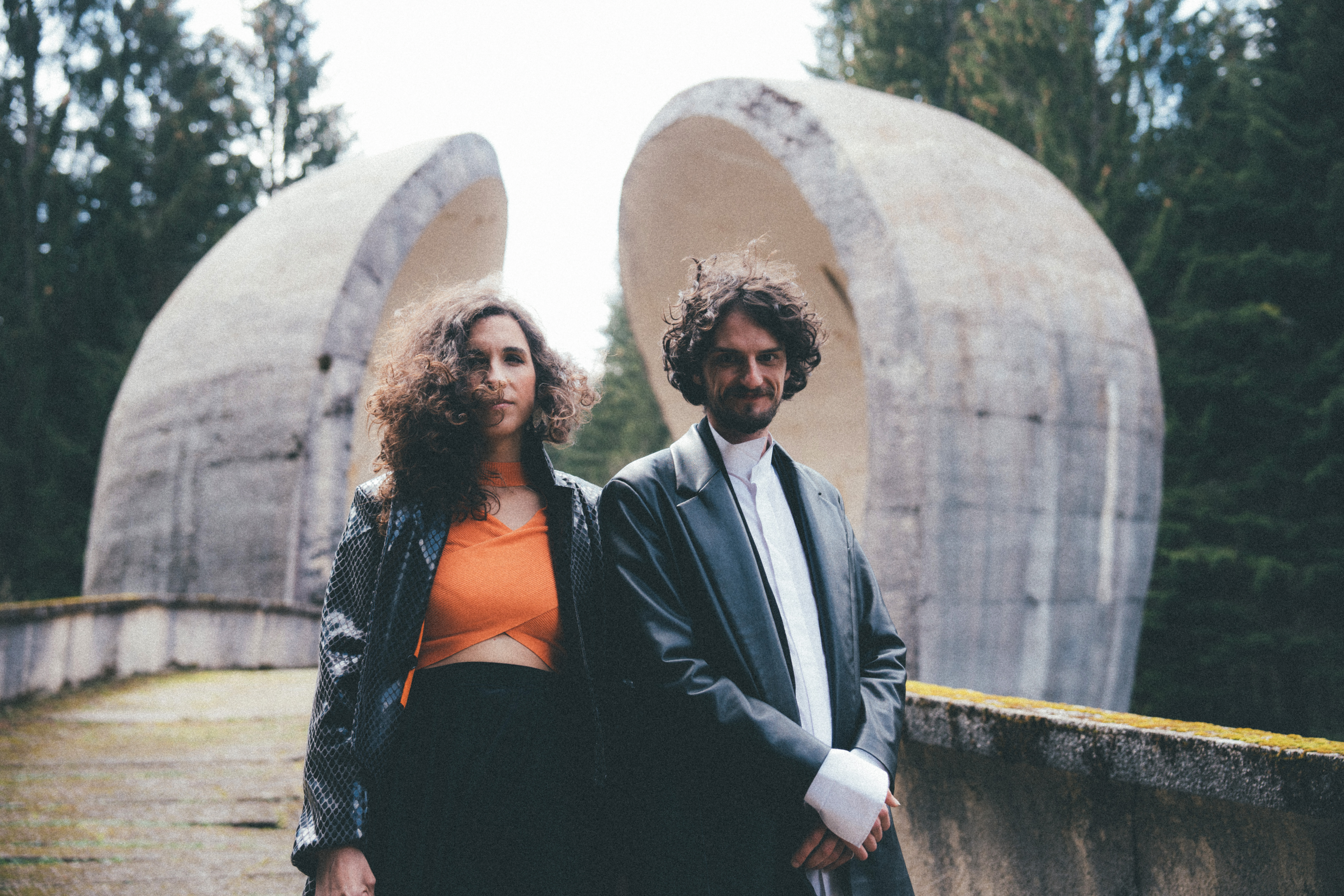
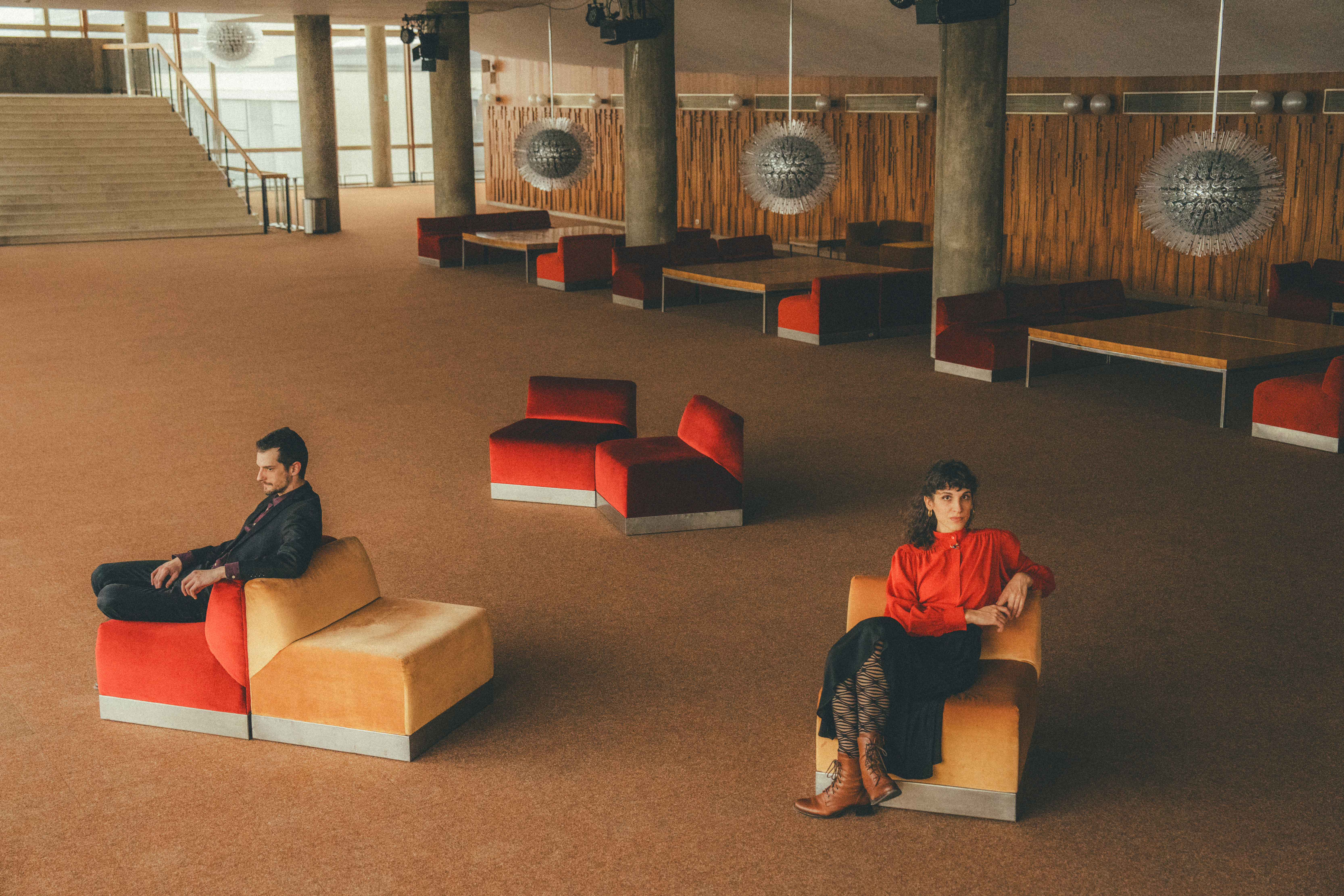
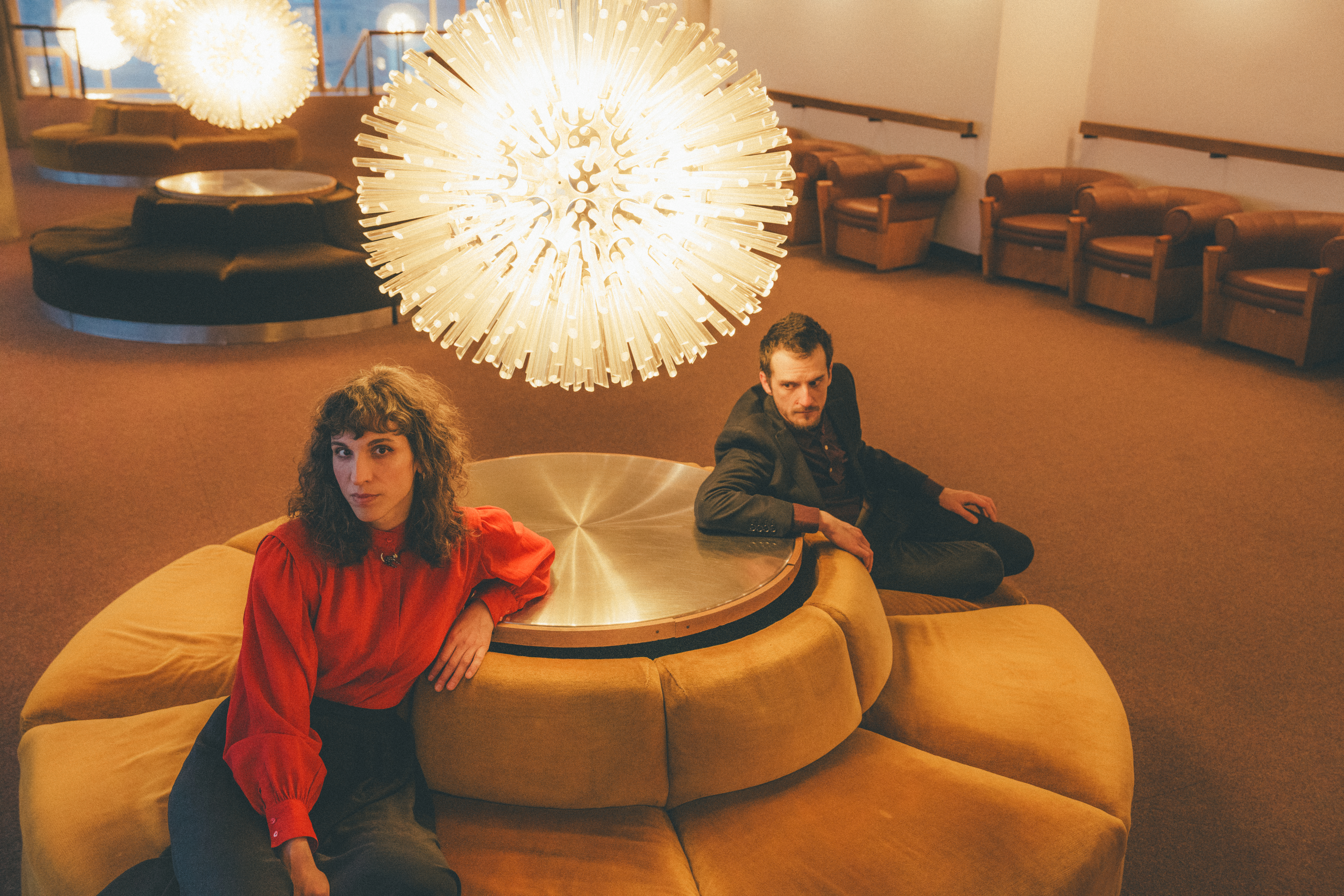
She, Dunja Bahtijarević, singer and poet. He, Luka Čapeta, guitarist, producer, and teacher. Both are courageous artists who love all the risks that culture can offer to the most daring. Their innate restlessness compels them to embrace nonconformity to unsuspected limits. Since late 2019, based in Zagreb, the duo decided to delve into the grandiose world of Sevdah. Without any limits, and riding the most extreme experimentation, Dunjaluk are determined to give several twists to a genre that allows for a thousand possibilities. With their self-titled first album (2022), they baffled everyone. Vrbas (2025), their second creation, consolidates their style and opens up new possibilities. In their own words, Dunja is looking for herself in Sevdah, and Luka is looking for Sevdah in himself. The result may be unpredictable. We shall see.
«Where our interest about it begins is in bringing this music to the younger people of today, while hopefully bridging the gap between them and the generations preceding them» (Luka)
«I am inspired by traces of «punk attitude» in traditional music; in it I find justification for what we do and a lot of encouragement» (Dunja)
«The language of Sevdah has a lot of place for interpretation and unique approaches; the idea is to find your own expression and present it» (Luka)
By César Campoy.
– The first question, although predictable, is necessary. How did your passion for Sevdah begin, and how did you, a singer and a guitarist from Zagreb, decide to immerse yourself in such a complex universe?
– Luka: Before Dunja approached me with her proposal to play this music, I didn’t have much of an opinion about it since I didn’t know of many people who performed it. I was always a fan of Arabic, Turkish and Middle Eastern music and as I’ve started to listen and investigate more thoroughly, I’ve found many interesting connections. I guess the real moment of passion came to be with understanding of how this music comes from my mother tongue, and how it’s easy to connect to the meaning and feeling of the music. When Dunja and I started working on it, the ideas started to flow easily and we felt like we had opened a new, authentic path for ourselves.
– Dunja: I was interested in Sevdah for a long time, being from Bosnia and being a singer, but it took ages for me to find likeminded collaborators. It’s not easy to say something new using tradition. You have to be able to unhear everything you heard before. When I met Luka I felt that we could be a good fit for the task, also because he wasn’t very familiar with Sevdah.
– There’s a misconception that Sevdah is a music exclusive to Bosnia and Herzegovina, but the rest of Yugoslavia also has renowned sevdalinkas. Furthermore, many of the historic musicians and singers were born outside of Bosnia and Herzegovina. Of course, Croatia has also produced, over the decades, great Sevdah performers, composers, instrumentalists, and producers. Obviously, record labels as well. It’s interesting that, in recent decades, several Croatians have collaborated in reinventing the genre: Ibrica Jusić, Dunjaluk, Nenad Kovačić (of Damir Imamović’s Sevdah Takht), of course, the great Josipa Lisac… What has been the historical relationship between sevdalinka and Croatia?
– L: My guess is that in the times of Yugoslavia and before, the musical connections among the people in the region were more open and fluent, songs were sung freely among the people and used as a medium for communication. In Croatia, sevdalinka is mostly very popular among the older generations. Where our interest about it begins is in bringing this music to the younger people of today, while hopefully bridging the gap between them and the generations preceding them. We find the meanings of these songs are profound and timeless, so it must mean that a certain bridge for communication exists there, somewhere.
– D: I agree with Luka. We used to be part of the same country, and the state was encouraging the recording and promotion of traditional music, so different styles were able to reach far beyond the areas of their origin. But of course, we are still part of a large cultural circle that has nothing to do with national borders, and it’s easy to recognize yourself in the music that is in one way or another not considered “yours”. I think such limitations make no sense.
– One of the most interesting aspects of Sevdah is that the same sevdalinka can vary, not only depending on the region in which it is performed, but also differences (for example, in the lyrics or the title) between two neighboring towns. Is it easy to establish different types of sevdalinkas based on geographical appearance?
– L: L: As with many songs stemming from tradition, they travel through these countries and regions and morph themselves to fit the various cultures. However, I’m still far from an expert in the different origins of sevdalinka, so I’ll let Dunja speak about it more.
– D: After years of taking care to research every song I sing, I started to lose interest in ethnological and ethnomusicological aspects of the music. I’m now happy with a more artistic approach: being drawn to a song, seeing what it says to me, sometimes changing it to say something more clearly or to say something new, putting it in a context that I find interesting. Might be controversial, but if I’m honest, that’s what I do now.
– Simply by the way you approach the genre, by the way you give it a twist full of experimentation, you would have every right to be on the New Sevdah podium. Do you feel part of that movement that, since the late 1990s, has managed to renew sevdalinka and give it a new lease of life, turning it into a genre with international reach?
– L: Not necessarily. My personal perspective is that this approach we use is very alien to the people in the region of the Balkans, especially those in Bosnia, just because the need to preserve culture in its latest form is so present. The further away we go from the source, the more our intention is heard and understood or at least, enjoyed but only when we use the album as a reference. In a live setting, people seem to connect easily to the moment and the music. To finally answer your question, from a musicological perspective we could be a part of this movement but in a sense of culture and recognition or acknowledgement in our region, we are definitely not recognized as such, yet.
– D: I do feel a part of that movement because our approach can be described as renewing Sevdah. At the same time I don’t necessarily see it as a movement, because I’m not sure we influence each other, or that there is a common interest or goal. And living in Zagreb, there is no communication. As for what Luka is saying about audience expectations, we haven’t played in Bosnia yet, so we can’t know what the reactions are, or what they would be. I’m sure we would find likeminded listeners.
– We’re talking about artists like Dream, Mostar Sevdah Reunion, Damir Imamović, Amira Medunjanin, Halka–Božo Vrećo, Divanhana, or, more recently, Igor Božanić. Which of them do you most identify with?
– L: In my personal opinion, as artists we all pull from the same source when it comes to the core language of the music. However the ideas and inspirations we pull from are so different and especially the ideas of what we do with the music aesthetically and how we present it. I think this is the beauty of Sevdah and it’s freshness when it comes in contact with artists of our generations. We all get to find our own meaning and tell our own stories through it by which we get to communicate with a wide range of musical audiences. We belong to each other and we all contribute in adding possibilities to what sevdah could be. There is still plenty of room for people to add to this diversity as this music is in my opinion a very flexible and solid musical language which holds bridges to many different musics ranging from classical, modern classical, jazz, experimental, rock, electronic…
– D: I agree. I’m happy that the different approaches result in different aesthetics, so that anyone can find a version of Sevdah that suits them. Sevdah can only benefit from that!
– And, among the classical artists, which ones do you look to for inspiration when building your technique and sound, both on the guitar and vocals?
– L: To me, Olivier Messiaen, Edgar Varese, Xenakis, Gesualdo di Venosa, and of course Bach and many other greats, are always a reference in some way in anything I do. However I was very surprised to find more space for these references in sevdah than in any other music I’ve done so far. The ability to use, or just to think about, their harmonic and rhythmic languages and ideas in opposition to Sevdah, for me created a whole new world of possibilities. The further we go down the road with our music, the more of this influence will be heard, surely.
– D: My parents are big fans of classical music, and as a kid I loved composers who worked with tradition, like Smetana and Bartók. Nowadays I love Arvo Pärt for example, and the work of Kronos Quartet. But I think other things influence my approach to voice.
– Now that we mention Amira, it’s clear that you’re walking on a different, more experimental wavelength. However, your magnificent reworking of Bogata sam, which opened your first album, Dunjaluk (2022), reminded me of the one Medunjanin recorded on Rosa (2005), featuring Miralem Bašić’s electrified, broken saz. Were you familiar with that version? Were you inspired by it?
– L: I honestly didn’t know anything about modern Sevdah at the time we were making the record. I somehow decided I wouldn’t refer to it too much, but rather, the trick was to see what my natural reaction to the music would be. As much as I respect Amira‘s work, it’s so far away from the aesthetic and approach to the music and performance I trained myself for, that I hardly recognize it as the same music. Still, her music communicates to a big audience and the rules in music making are different in that sense.
– D: I’m not familiar with that version of the song either! I usually avoid listening to newer interpretations when I decide to work on a song, and I stick to older recordings, so that I’m not influenced or limited by other modern ideas.
– I imagine that both current reworkings do draw from that legendary interpretation by maestro Muhamed Mešanović-Hamić (1966). I find it very intriguing how, using modern settings and sounds, you reclaim, with guitar and voice, the essence of Sevdah, its roots, its origins: Voice and saz. Is that right?
– L: The version of Muhamed Mešanović-Hamić was the first time I ever heard Sevdah in its root form and it left a big influence on me as well as it showed the direction in which I should go with understanding the music. Our version of the tune is certainly influenced by him, while it evolved into something on its own with time, which I’m really happy about.
– D: Yes, that’s the version that influenced us. I find that Mešanović-Hamić does something quite modern in saz instrumental parts. It moves me very much. I am inspired by traces of “punk attitude” in traditional music, which of course existed in human experience before punk music. And in it I find justification for what we do, and a lot of encouragement.
– The clash is brutal: extreme modernity and avant-garde, to pay homage to the tradition of several centuries ago. Is that one of your goals?
– L: Well, our goal is surely to challenge ourselves and the music in finding the limits of its flexibility. So far I have a feeling we barely scratched the surface. In a sense, this current work we have done so far is not even as extreme as it might be. The molding of this music came to us naturally because the all music we listened to and learned through our individual paths has found its place in those interpretations. I guess that it sounds extreme mainly because we were not raised in the tradition as thoroughly as other artists you’ve mentioned, so our pool of reference is bigger. In the end, it’s all about finding a certain depth, to present the lyrics and the song in a way where it can make the most impact, along with the element of surprise, so vital to music anywhere.
– D: I don’t think our goal is to be extreme. For me it’s to bring my experience, both human and musical, into traditional music. To sing traditional music as myself. To adapt Sevdah to my voice, and not the other way around. And to bring another kind of emotion to Sevdah. At concerts I often joke that we are modern people who want to express our emotions, instead of restraining them. In Sevdah there is rebellion that is often only subtly expressed, even masked. I think it’s time to bring that out, too.
– At what point, with change and evolution, does tradition risk ceasing to be tradition? Do you draw any kind of red line?
– L: In my opinion, tradition is tradition and using it to create something new will not stop it. In case of war and genocide, there is a big risk of it dying out, because tradition is people. I think at least in the context of Sevdah, the tradition of it, and preservation, there’s nothing to fear because it’s in good hands of the people who are on the forefront of its name, keeping it alive and working in its evolution in a careful way. Having said that, I think what Dunja and I do is also a part of it no matter what we do with the music. I think this level of change and experimentation we introduced to the music is a natural aspect of it, and it doesn’t really do anything to remove its core values and meanings. In the end, from tradition new traditions are born and they live their separate lives. I think a sign of a great tradition is its ability to generate more shapes and forms from it. In that sense, sevdah is a great tradition, very intricate as much as it is flexible.
– D: We don’t draw any red lines. I think it’s a matter of sensibility, and of trusting our own sensibility, our own sense of truth – you can obey the “rules” and create a monster, or do something “forbidden” and create something very beautiful and true.

– The duo’s name is a play on your surnames, but it has a lot of possibilities for interpretation, doesn’t it?
– L: It means «this world».
– D: The play on our names is not so important. It’s a gimmick that allows for an “aha!” moment when people find out the meaning of the word, which doesn’t exist in Croatian. It’s about discovering new layers. And about bringing the elevated, canonised tradition of Sevdah back to the common people, grounding in the realm of this world and its phenomena.
– Let’s talk a little about your EP Vrbas, released in May 2025. It’s a kind of continuation of your first album, with unreleased tracks and some reinterpretations. Does it mark the end of a cycle and the beginning of a new one?
– L: It kind of marks both, we are still not going to run away from what we did so far but a new vision has come to us, of how we can go further with our ideas and this music.
– Telal viče and Čudna jada resemble what we already knew, your original style. We find the differences, for example, in the new live versions of Džidža and Vrbas, with the Austrian trio Wh/m. How did that collaboration come about, and what conclusions do you draw from it?
– L: The collaboration was an idea of the creative director of Glatt&Verkehrt festival, Albert Hosp, who proposed we share the stage by playing each other’s music together, in new arrangements. It was a very interesting and fun experience as we got to solve the equation of their musical language and ours. We thought it went rather nicely. The conclusion is that this music can go further in many directions as it did in this interpretation with these amazing jazz musicians. Their sensibility brought many surprises and we’d love to create something more in the future, together. It only strengthens the idea how this music is flexible and able to go outside of its box and still remain what it is.
– The remix of Kamen gori by renowned producer (Vladimir) Lenhart Tapes deserves a special mention, as it’s completely different. Was it his suggestion, or yours?
– D: We met Vladimir at Balkan:Most Festival in Veszprem. I already really liked his work, and it was a nice encounter. We suggested the collaboration some months later, when he had a concert in Zagreb. We proposed that he choose a song to remix, and it was Kamen gori, which we kind of expected anyway. For us it was the song that really determined our approach when we recorded it, and I guess he heard that.
– The scale that Kamen gori takes on with this remix is overwhelming. It manages to multiply your stylistic philosophy a thousandfold, don’t you think?
– L: I think what we do and what Lenhart does is in its own crazy way very connected. His approach to the sounds of our region is exactly in the spirit of our vision, no matter how different our materials are. The combination of our ideas created something very intense and open, and I would like for this to happen in the future again. I think more people should give attention to what he does and especially if they can, attend one of his shows.
– D: I think his additions really emphasized the neurotic, unhinged aspect of the emotional world of the song, pushing aside the sadness and pride that are there. He really added something significant.
– Lenhart works with the agency and record label Pop Depresija (interestingly, a team that also works with Igor Božanić). Are you planning to join the Pop Depresija family?
– D: It seems to be an interesting family working with artists we love, but there were no talks about joining.
– By the way, does this EP pave the way for new collaborations?
– L: Possibly, we have some ideas who we could work with on some tunes. It depends on what we create and also on the circumstances. Our collaborations have mostly been spontaneous and ideas of third parties so far.
– Are you open to giving more prominence to your original compositions, or will your work continue to be based on breathing new life into sevdalinkas?
– L: We are currently working on opening that space too, on finding a way to keep the tradition there and also create something new and possibly open new doors for us, and everyone.
– Where is your path heading, and where is that of 21st-century Sevdah heading?
– L: I honestly don’t know. I know what I personally would like for it to be. I see a future where this Sevdah scene opens up with more artists from the region finding their way with it, hopefully more experimental and crazy but still keeping it’s profoundness and depth. I believe the language of Sevdah has a lot of place for interpretation and unique approaches. The idea is to find your own expression and present it. Our path is certainly one of slow dedicated focus to creating more and also finding different ways for us to do it.
– What are your short- and medium-term plans?
– L: We are working on something new. It will take time as we always take time to do things. In the meantime we are planning some possible collaborations and concerts.
Lee esta entrevista en español
——————————————

Sevdalinkas: 150 joyas del Sevdah, por César Campoy
 sevda linkas